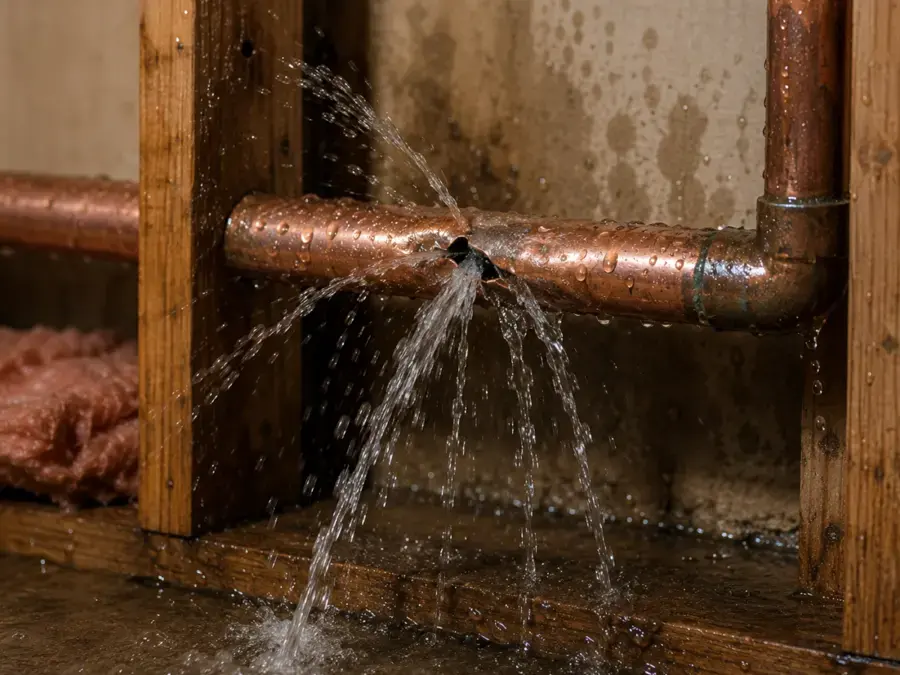
Burst pipes in Hyattsville come from two very different housing stocks. Pre-war homes in the historic district and around Route 1 often still carry galvanized steel supply lines that rust from the inside, while 1950s and 1960s brick homes and garden apartments have aging copper with worn joints. Either way, a failure inside a wall or ceiling spreads water where nobody can see it, so the restoration team maps before it opens anything.
What makes a pipe burst here
- Galvanized lines corroded from the inside until a section splits
- Old copper joints and fittings that finally give way under water pressure
- Pipes on exterior walls or in unheated porches that freeze in a January cold snap, covered on the frozen pipe page
- Pressure spikes and aging shutoff valves in older buildings
How burst pipe damage is dried
The extraction crew removes standing water first. The tech who does the walkthrough then uses a thermal camera and pinless meters to trace how far the water moved inside the walls, along joists and under flooring. Small, controlled access holes at the base of a wall let the drying team push dry air into the cavity, which often saves the drywall or plaster instead of tearing it out. Air movers and LGR dehumidifiers run until the readings match a dry reference.
Clean water does not stay clean
A burst supply line starts as Category 1 water. After it sits for a day or two, or runs through dirty cavities and flooring, it can become Category 2, which changes what can be saved. Fast extraction keeps more of the house in the dry-in-place column.
Plaster, hardwood and multi-unit buildings
Plaster walls and old hardwood floors hold water far longer than drywall and engineered flooring, so drying in older Hyattsville homes often runs toward five days or more. In garden apartments in Langley Park, Chillum and Adelphi, a burst line upstairs often shows up as a ceiling leak in the unit below, and both units need readings. For leak prevention tips, see EPA WaterSense Fix a Leak Week, and for cold-weather pipe protection see Ready.gov winter weather.