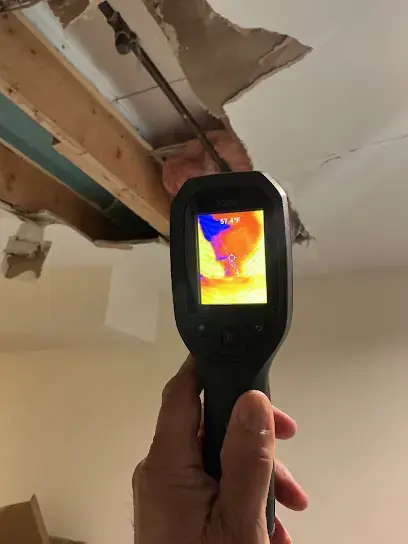
Ceiling leaks are one of the most common water calls in the Hyattsville ZIP codes because so much of the housing is stacked. Brick garden apartments in Langley Park, Chillum and Adelphi, condo buildings near Prince George's Plaza and the newer mid-rises along Route 1 all put one kitchen or bathroom directly over another. A supply line, toilet, tub or washer failure upstairs becomes a stain, a drip and then a sagging ceiling downstairs. In single-family homes, the same thing happens under a second-floor bathroom.
What causes ceiling leaks here
- Toilet supply lines, wax rings and tub drains that fail in the unit or bathroom above
- Washer and dishwasher hoses on upper floors, covered on the appliance supply line page
- Radiator valves and boiler lines in pre-war houses, covered on the radiator and boiler leak page
- Roof and flashing leaks that reach the top-floor ceiling, covered on the roof leak page
How a wet ceiling is dried
The tech who does the walkthrough uses thermal imaging and meters to find the wet area and follow the water back to its source, often across several joist bays. If the ceiling is bulging with trapped water, the team drains it in a controlled way before it falls. The drying team then dries the ceiling and the cavity above, usually with small access holes and directed airflow, and dehumidifies the room. Drywall ceilings often dry in place; plaster ceilings on wood lath need closer checks because the keys that hold plaster up can loosen when wet.
Two units, two sets of readings
In a multi-unit building, the water usually touches the floor above and the ceiling below. The restoration team records readings for both spaces, which helps the building owner, both tenants and the insurers sort out the claim.
When the ceiling has to come down
Sections come out when the drywall has sagged, the plaster has separated from the lath, or the water was Category 2 or 3, such as a toilet overflow. For water leaks at the source, EPA WaterSense has simple checks for toilets and fixtures, and the EPA mold pages explain why a wet ceiling should dry within 24 to 48 hours.