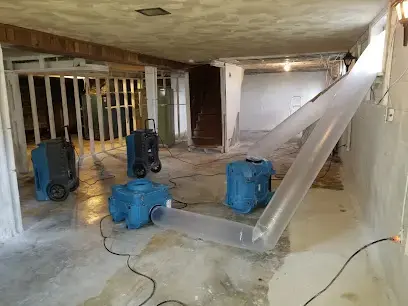
Structural drying is the part of water damage restoration most people never see, and it is the part that decides whether the job is really finished. IICRC S500 is the industry drying standard, and it treats drying as a measured process: find every wet material, set the right equipment for the room and the material, and prove the result with readings. In Hyattsville, where so many homes combine plaster, old hardwood, brick and newer drywall additions, one house can hold four different drying problems at once.
How the drying team plans a dry-out
- Moisture mapping with pinless and pin meters and thermal imaging before any equipment goes down
- A dry reference reading taken from unaffected material of the same type in the same building
- The loss classified by category (how clean the water is) and class (how much water and how porous the materials)
- Air movers set to the evaporation load of each room, and dehumidifiers sized to pull that moisture back out of the air
Equipment matched to old and new materials
LGR (low grain refrigerant) dehumidifiers handle most rooms. Dense Class 4 materials, such as plaster, brick, stone and old hardwood, often need desiccant dehumidifiers that dry air far below what a refrigerant unit can reach. Wall cavity kits push dry air behind drywall and plaster through small holes, and floor drying mats pull water up through hardwood. The drying team closes the room so the equipment works on a controlled space instead of the weather outside.
The drying goal
Equipment comes out when wet materials read within 2 to 4 points of the dry reference, not on a set day. A contained Class 1 or 2 loss usually dries in three to five days; plaster, masonry and hardwood take longer.
Daily readings and the claim file
Every day the crew records moisture readings at marked points plus temperature and humidity (psychrometric readings) inside and outside the drying zone. Those logs, the first moisture map and timestamped photos go into the file your insurer reviews. Drying follows water extraction on nearly every job. For the science of moisture and mold risk, see the EPA mold pages, and for home moisture topics in Maryland see University of Maryland Extension.