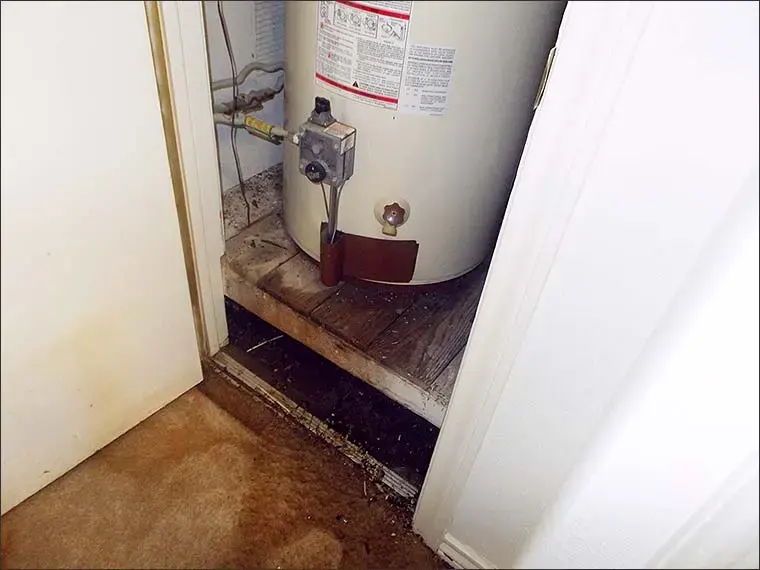
Most tank water heaters last roughly 8 to 12 years before the steel tank corrodes through. In Hyattsville, many sit in unfinished basements of older houses, where a failure floods the slab and soaks whatever is stored nearby, while garden apartments and condos often tuck them into a hall closet, where the water runs under walls into bedrooms and through the floor to the unit below. The extraction crew handles both.
How water heaters fail
- The tank corrodes and splits, releasing its full volume at once
- The temperature and pressure relief valve opens or leaks and the discharge pipe runs to the floor
- Supply connections and drain valves at the base of the tank start to drip
- A drain pan that overflows or was never installed in a closet unit
How the cleanup is handled
With the cold supply closed and the power or gas off, the extraction crew removes the standing water. The tech who does the walkthrough checks the walls behind and beside the tank, the floor of the next rooms and the ceiling below if the heater sits upstairs. Closet heaters in apartments often wet the bottom of three or four walls. The drying team dries the cavities through small openings where needed and runs dehumidifiers until the readings reach the goal. A plumber replaces the heater.
Old tank water is not always clean
Sediment and rust from the bottom of an old tank come out with the water. The team classifies the loss by what the water carried and touched, and a long-running leak into a dirty basement can move it to Category 2.
Upstairs heaters and the unit below
When a closet heater fails in a stacked building, the water often reaches the ceiling below within minutes; see ceiling leak water damage for how that side is dried. In basements, the work overlaps with water extraction. For water heater efficiency and replacement basics, see the Department of Energy water heating page, and for leak checks see EPA WaterSense.